Create checksums, protect text with encryption, sign and verify messages, and compare private text in endpoints, server functions and events. Find these commands under Security when adding a command. They use the familiar variable selector and Return as field.
Keep shared signing keys in Globals & secrets and choose their $secrets.NAME reference rather than writing a private key into a command.
Choose text to produce its checksum, a 64-character hexadecimal result. Exactly the same text produces the same result; changes to spaces, line breaks or letter case produce a different result.
For example, the digest of abc is ba7816bf8f01cfea414140de5dae2223b00361a396177a9cb410ff61f20015ad.
Use this to check whether content changed. A checksum does not prove who sent it. For passwords, keep using Hash Text and Match Hashed Text; a fast checksum is not a password-storage method.
Choose message, the exact text to sign, and secret, the shared signing key. The result is a 64-character hexadecimal signature.
Both sides must use the same message text and secret. Follow the other service's signing instructions: some services sign a timestamp together with the body, rather than the body alone. Do not change spaces or reformat the message after signing it.
Choose the exact message, the shared secret and the received signature. The result is true when they match, or false when they do not. Use a condition to stop the workflow before making changes if verification is false.
The signature must contain exactly 64 hexadecimal characters. Uppercase and lowercase hexadecimal characters are accepted. If the service sends a prefix such as sha256=, remove that prefix before passing the signature to this command. Other signing formats or algorithms need their own matching verification method.
Use this when a service signs the original JSON request text. It returns the original body text, preserving spaces and line breaks. Rebuilding text from the parsed body can change it and cause signature verification to fail.
A typical webhook workflow is:
Read the signature from the request header specified by the sending service.
Use Get Raw Request Body and retain its output as raw_message.
Use Verify HMAC SHA-256, selecting raw_message, your workspace secret and the received signature.
If the result is false, return an error before changing any records.
Check the sender's timestamp and whether this event has already been processed, then continue with the intended action.
The raw body is available for real JSON endpoint requests up to 100 KiB. It is null in tests, events and requests without a captured JSON body. For an editor test, supply a known message as text; then check the real webhook flow with the sending service.
A valid signature alone does not prevent the same message being sent again. Use the sender's documented timestamp rules and an event ID or other duplicate-processing check before payments, stock changes or similar actions.
Choose left and right to compare two exact text values using a comparison designed for private values. The result is true when the text matches and false otherwise, including different lengths.
This does not verify a webhook's signing rules or make a reusable password hash. Use the dedicated HMAC verification and password commands for those tasks.
Generate a fresh encryption key for Encrypt Text. The result is a random key encoded as text. Keep it securely, for example in Globals & secrets, and use the same key when decrypting saved data.
Generate a key when setting up or rotating encryption, rather than generating a different key every time you want to read an existing encrypted value. Losing the key means the protected text cannot be recovered. Keep a secure recovery copy according to your own key-management process. Test results and traces hide generated keys.
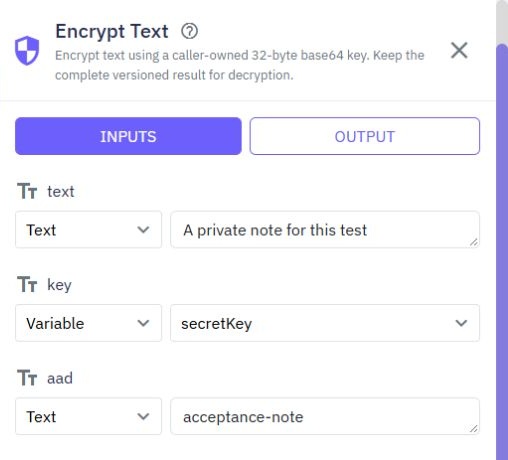
Choose text, the exact text to protect, and key, a 32-byte key encoded in base64. Generate Secret Key creates a key in the correct format. Select a saved key through $secrets.NAME instead of writing it into the command.
The command uses authenticated AES-256-GCM encryption and returns an object containing version, algorithm, iv, tag and ciphertext. Keep the complete object together, for example as a field in your saved record. The command creates a fresh random nonce automatically, so encrypting the same text twice produces different encrypted results.
Optionally choose aad, associated text such as an order ID. This ties the encrypted value to that context. Use exactly the same associated text when decrypting. Associated text is not encrypted or included in the returned object; keep it available separately if you use it.
Encryption does not save the result automatically. Add a database command to store the returned object if it needs to survive the current run.
Choose encrypted, the complete object returned by Encrypt Text, and the same key. If encryption used associated text, supply that same aad.
The result is the original text. A changed ciphertext, missing or changed tag, wrong key or different associated text produces an error; the command does not return partially decrypted text. Use the versioned object unchanged. Other encryption formats or older encrypted data need a matching decryption method.
Encrypt and Decrypt support text up to 1 MiB. Associated text supports up to 16 KiB. Keys must use the exact generated base64 format; ordinary passwords are not valid encryption keys.
Use a private/public RSA key pair supplied for your integration. Select message, the exact text to sign, and private_key, an unencrypted PEM private key held in a workspace secret.
The result is a base64 signature using RSA with SHA-256 and PKCS#1 v1.5 padding, often called RS256. Share the corresponding public key with the receiving service; keep the private key private. Do not use the symmetric key from Generate Secret Key here: encryption keys and RSA key pairs are different.
Select message, public_key and the received base64 signature. The result is true for a valid matching signature and false for a mismatch or malformed signature. Use a condition to stop the workflow when it is false.
The sender must use the same RSA signing method. This command accepts a public PEM key, not a private key or a certificate. It does not check a token's issuer, audience or expiry, and does not replace your existing login or authentication-token commands.
RSA keys must contain 2,048 to 4,096 bits. PEM key text supports up to 16 KiB, and messages up to 1 MiB. Password-protected PEM private keys and other key types are not supported in this version. If cryptography is temporarily busy, the workflow receives an error instead of waiting indefinitely; retry only when doing so will not repeat another important action.
These commands accept UTF-8 text. They do not automatically convert objects, lists or numbers into message text. Each text input supports up to 1 MiB. HMAC secrets must be nonempty and no larger than 16 KiB; signatures must use the hexadecimal format described above.
Command values are hidden in execution-trace previews. Generated encryption keys and private signing-key inputs are also protected in supported diagnostics, including later log commands in the same run. Do not deliberately return a private signing key, copy it into a log message or include it in a customer-visible response. The digest or signature may be returned when that is part of the service's intended protocol.
These commands are available only in server workflows. Existing login, password recovery, password hashing and authentication commands retain their behavior. Text encryption protects the value you pass to it; it does not automatically encrypt an entire file, database or workflow. Protecting stored data also requires suitable access permissions and careful handling of the original text.
Send Message
Send SMS Command. With Twidget, you can send SMS messages to phones using the `Send SMS` command. This functionality varies depending on the provider. Currently, we support Twilio as the SMS provider. To use Twilio for SMS integrations, you will need: - A Twilio account ID - Twilio Auth Token - A Tw...
Return
The `return` command in Twidget is a special command used to halt the current command workflow and immediately return a specified result. This command overrides any subsequent processes and outputs the return result regardless of the rest of the workflow logic. This command is particularly useful fo...
Variables
Variables are essential building blocks in Twidget that allow you to store and manipulate data dynamically within your no-code applications. They enable you to create flexible and interactive applications by holding values that can be changed and referenced throughout your workflow. Creating Variabl...
Advanced file commands
Prepare CSV downloads, work with small ZIP archives and share a temporary download link from an endpoint, server function or event. Find these commands under File Manager when adding a command. Use the usual variable selector and Return as field. The existing file commands still handle storage, fold...
Security
Twidget provides several built-in functions to enhance the security of your applications. Below is an overview of each security command, including its description, inputs, and outputs. For checksums, shared-secret signatures, webhook verification and safe text comparison, see [Cryptography commands]...

