


Database Exports
Export records from a Twidget table.
Recorded with an earlier Twidget interface. Names, control locations and available options may differ; use the linked documentation for current guidance.
Watch tutorial (1:40)
Export records from a Twidget table.
Recorded with an earlier Twidget interface. Names, control locations and available options may differ; use the linked documentation for current guidance.
Watch tutorial (1:40)Twidget allows you to export data from your database tables to a CSV file. This feature supports the export of both complete and filtered datasets. Here’s how you can utilize this functionality:
Format: Export data in CSV format.
Data Handling: Object and list data types within your tables are automatically converted into JSON format in the CSV file.
Filter Options: Export either all records in your database table or only the filtered results according to your specific criteria.
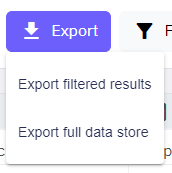
Navigate to the Table: Go to the database table from which you wish to export data.
Initiate Export: Click on the export button/icon.
Select Export Type: Choose the option to export all records.
Download CSV: Your CSV file will be generated and available for download.
Apply Filters: Set the specific filters on your table to narrow down the data you want to export.
Initiate Export: Click on the export button/icon.
Select Export Type: Choose the option to export the filtered results.
Download CSV: Your CSV file containing only the filtered data will be generated and available for download.
The CSV format is currently the only supported export format.
Object and list data within any column will be serialized into JSON strings within their respective cells in the CSV file.
Filter Data
In Twidget, you can easily filter and sort data within the database tables view. This allows you to refine and manipulate the data as needed. Below are the steps and options available for filtering and sorting data. Filtering Data. To filter data: 1. Click on the Filter Button: In the table toolbar,...
Database Indexes
Indexes help Twidget find records quickly. A unique index also prevents duplicate values from being saved. Choose the right index. Use a lookup index for a field you regularly filter or sort, such as an order date. Use a unique index when a value must not appear twice, such as a membership number. A...
External Database Connections
Read records from an existing external database without copying all of its data into Twidget. Add a connection. 1. Select your workspace and open Settings → Database Connections. 2. Select Add database connection. 3. Choose the provider: PostgreSQL, MySQL, SQL Server or Snowflake. 4. Enter a connect...
Adding Database Table Rows
In Twidget, you can easily add new entries (rows) to your database tables. This feature allows you to expand your data dynamically without the need for complex coding. This document provides a step-by-step guide on how to add rows to your database tables. Adding a New Entry to a Table. To add a new ...
CSV Import
Twidget enables seamless import of data from a CSV file into your database. Follow the steps below to successfully import a CSV file. Step-by-Step Guide. 1. Initiate the Import: - Click on the Import button within the table toolbar. - Select Import from CSV from the dropdown. 2. Open Import Dialog: ...