Action Stats gives Twidget administrators a history of endpoint calls and event runs. It is an admin tool, rather than a workspace feature available to every team member.
Open Action Stats in the admin sidebar. Filter by workspace, organization, action type, test or real call, result, status code, date, duration or timeout. Advanced filters help you find a particular action, trace, stage or operation.
This example filters a development workspace's calls by response code 401.
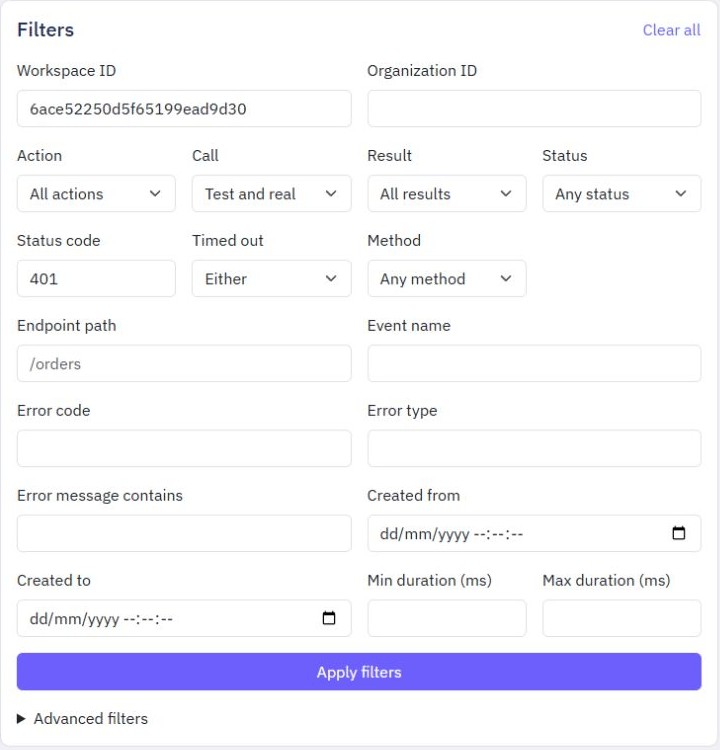
Select Apply filters. Select a table heading to change sorting; its arrow shows the direction. The default is newest created date first. Use the page controls to move through results.
Select a row to expand it. You can review the duration, timestamps, workspace and organization IDs, endpoint path or event name, result, error information and timeout details.
You can also focus a row with Tab and press Enter to expand or collapse it. On a narrow screen, scroll the table sideways to reach the other columns. The filters and page controls stay outside the table's scroll area.
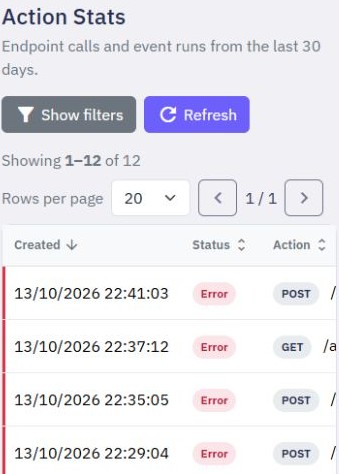
The narrow-screen example below shows a filtered list of errors. Scroll within the table to reach the other columns.
A successful acknowledgement for an event does not mean the event itself succeeded. Its recorded result reflects the background execution.
Action Stats entries are kept for 30 days and then cleared automatically.
API Limits
API limits help you control how often people can call the endpoints in a workspace. You can set a short-term limit and a monthly allowance. Set workspace limits. 1. Select the workspace you want to manage. 2. Open Settings, then API Limits. 3. Enable API limits. 4. Under Allowance per, choose user o...
Custom Endpoints
In addition to generating CRUD (Create, Read, Update, Delete), authentication, and file management endpoints, Twidget allows you to create completely custom endpoints from scratch. These custom endpoints give you full control over the various aspects of endpoint configuration, including the inputs, ...
Response Settings
You can customise the successful response from an endpoint, including its status code and additional headers. Configure a response. 1. Open the endpoint and its Output editor. 2. Select RESPONSE. 3. Choose a status code or select a variable from the commands section. 4. Add a response-headers object...
Authentication
Twidget supports Bearer Authentication to ensure secure access to your endpoints. You can specify which endpoints should be secured or open. Once secured, an endpoint can only be accessed using a valid Bearer Token, which is generated via our API. Additionally, we provide functionality to generate a...
Generate CRUD Endpoints
What are CRUD Endpoints?. CRUD stands for Create, Read, Update, Delete. These are the basic operations required to manage data in a database. Each operation corresponds to a specific HTTP method: - Create: Adds new data (HTTP POST) - Read: Retrieves data (HTTP GET) - Update: Modifies existing data (...

